Building Australia’s Asia capability: Griffith Asia Institute contributes to a national initiative
Australia’s future security and prosperity are inseparable from its ability to understand and respond to the rapid shifts occurring across Asia. From intensifying regional competition to climate transition and the digital revolution, the Indo-Pacific is reshaping the global landscape. Recognising this, the Australian Government has launched an important inquiry into building Asia capability through the education system and beyond—an initiative the Griffith Asia Institute (GAI) strongly supports.
GAI welcomes the opportunity to contribute to this national process and has submitted a detailed proposal outlining how Australia can rebuild the depth and breadth of capability needed for effective engagement. The full submission is available on the Parliament of Australia website Submission 56 (page 3).
A timely and necessary government initiative
The inquiry, led by the Hon. Tim Watts, reflects growing concern about Australia’s declining demand for Asia-related study. While previous policy efforts—including the New Colombo Plan and DFAT’s Australia Awards—have generated valuable momentum, capability has eroded at a moment when regional engagement is becoming more strategically important than ever.
GAI’s submission argues that Australia’s current approach to building Asia capability has become fragmented, with a lack of “demand” for Asia capacity despite a growing Asian economic integration. To credibly and effectively bridge this capacity gap, we argue that the Australian Government should transition from a fragmented approach to a clear, national strategy based on three interconnected pillars:
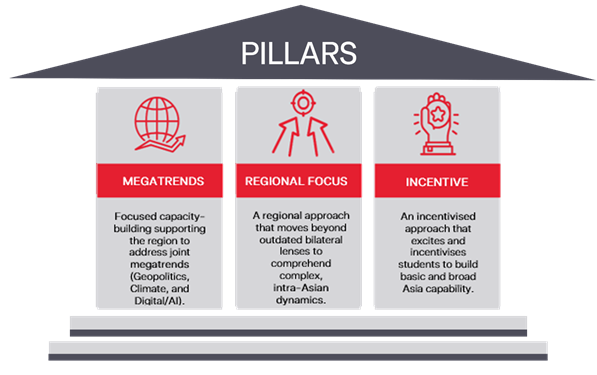
Megatrends reshaping Asia’s regional engagement
In the submission, we highlight three megatrends that, beyond important basic language and cultural skills, should anchor Australia’s Asia capability efforts to align with core interests and opportunities of our neighbourhood.
Geopolitics: Strategic competition—particularly between China and the United States—is creating uncertainty across the Indo-Pacific. Australia risks significant policy miscalculation if its understanding of major Asian powers remains shallow. GAI highlights deficits in granular knowledge about China’s domestic drivers, India’s evolving strategic posture and broader inter-Asian dynamics that increasingly shape regional decision-making.
Climate transition: Asia is simultaneously the largest source of emissions, a centre of green innovation and home to some of the world’s most climate-vulnerable communities. As regional economies accelerate decarbonisation, Australia faces risks to carbon-intensive exports such as coal and iron ore. Yet major opportunities lie in clean energy partnerships, hydrogen development and critical minerals—opportunities that require a workforce equipped with Asia-focused climate expertise.
Digital and AI transformation: Asia drives global digital growth, from datacentres and smart infrastructure to AI governance. Without strengthened digital literacy and policy capability, Australia risks being sidelined in the development of regional standards, weakening its influence and commercial competitiveness.
GAI is reinforcing the national conversation: insights from Perspectives:Asia
GAI’s recent Perspectives:Asia event on November 13 hosted The Hon Tim Watts MP. He powerfully echoed the urgency behind the submission. Speaking at the Queensland Art Gallery | Gallery of Modern Art, Watts warned that Australia’s Asia capability is “approaching crisis point” just as the Indo-Pacific’s strategic importance intensifies.
Watts argued that language learning, cultural literacy and regional experience are not optional extras but sovereign capabilities critical to Australia’s future. His reflections—interweaving policy insight and personal experience—reinforced the central message of GAI’s submission: rebuilding Australia’s Asia capability requires long-term investment, national coordination and a renewed commitment across the education system.
Looking ahead
Australia stands at an inflection point. The government’s inquiry is a timely and commendable initiative, and GAI is pleased to contribute to shaping a national approach that matches the scale of regional change. By aligning policy settings with the realities of a transforming Indo-Pacific, Australia can equip its next generation with the knowledge, skills and confidence needed to engage Asia with purpose and credibility.
Professor Christoph Nedopil is the Director, Griffith Asia Institute.